
«Archive as a Place for Memory and a Form of Resistance»
27.03.2026 — 28.03.2026, Berlin
Zukunft Memorial is organizing the Sixth Readings in Memory of Arseny Roginsky (1946–2017), which will take place on the eve of his 80th birthday. The conference will be held in Berlin and will be streamed online and translated into three languages: German, English, and Russian.
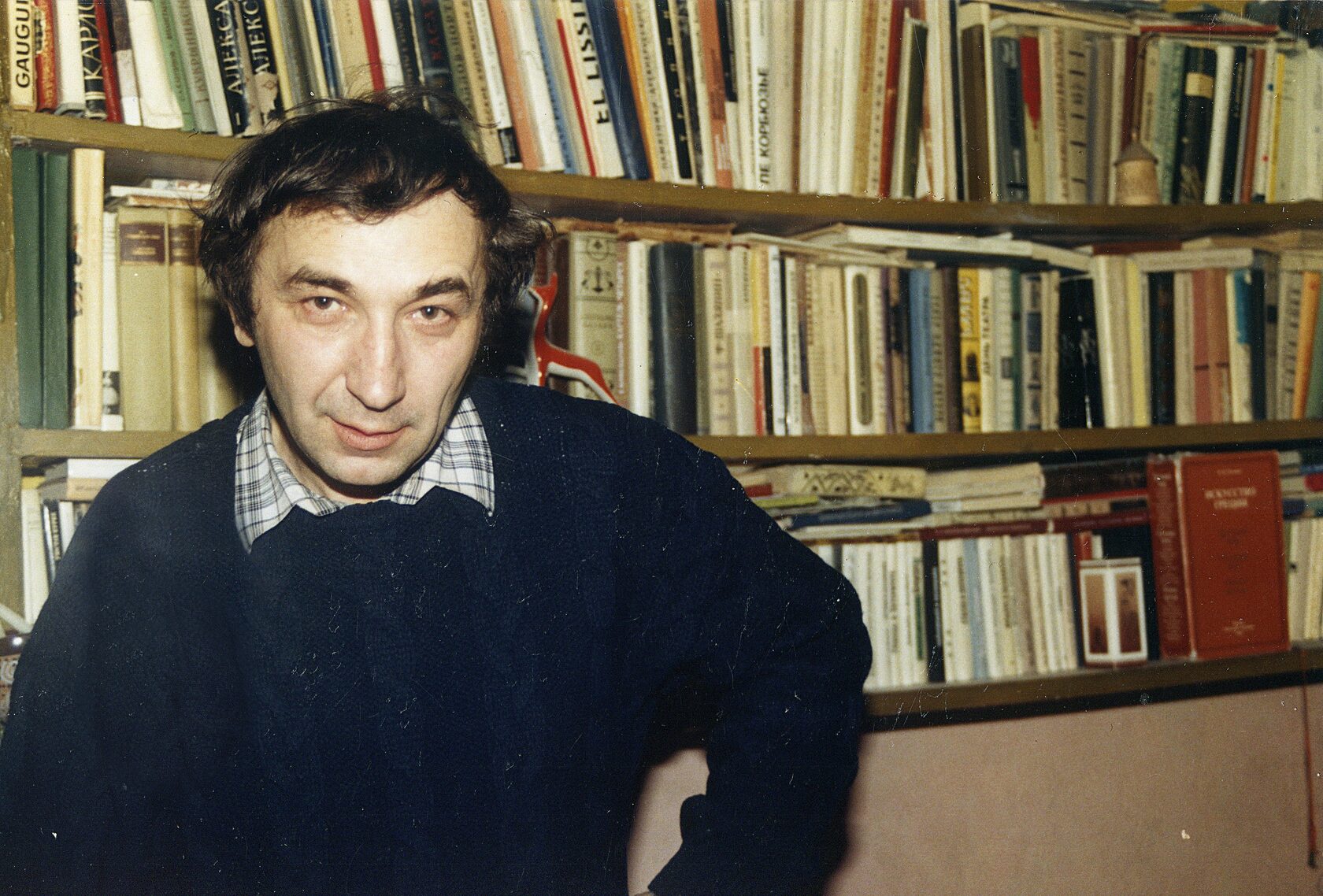
ARSENY ROGINSKY
(30 March 1946 – 18 December 2017)
Biographical Information
Arseny Roginsky’s father was an engineer at the Electrosila plant in Leningrad. In 1938 he was arrested and sent to a labour camp. After his release from the camp he was sent into "life-long exile" to the North, to the town of Velsk in the Arkhangelsk region, where Arseny was born. In 1951 Ber (Boris) Roginsky was re-arrested and died in custody. After his posthumous rehabilitation in 1956 the family returned to Leningrad. From 1962 to 1968 Arseny Roginsky was a student at the Faculty of History and Philology of the University of Tartu under Professor Yuri Lotman. Since 1965 he published articles and documents on the history of the Russian liberation movement in the 19th century, including some important documents about the Narodnaya Volya period. From 1968 to 1981 he worked in Leningrad as a bibliographer at the State Public Library and taught in evening schools.
Gradually, the scope of Arseny Roginsky's scientific interests expanded, and its centre of gravity shifted towards the history of Russia and the USSR in the 20th century. This was aided by his contacts while still a student in Tartu with future dissidents and human rights activists from Moscow. The motto of Roginsky’s and his colleagues' work in the 1970s can be summed up in his own words: "the need to recover historical memory" and "recreate an independent historical science". He and his friends attempted to realise this idea by founding the first samizdat historical collection, entitled Remembrance, which Arseny Roginsky compiled and edited between 1975 and 1981. "The editors consider it their duty to save from oblivion all historical facts and names which are now doomed to perish, to disappear, and above all the names of the dead, the hounded, the slandered, the fates of families broken or indiscriminately destroyed; and also the names of those who executed, defamed, denounced <...> The most important thing for us here is to retrieve historical fact from oblivion, rescue it from oblivion and put it into circulation – both scientific and public" (from the preface to the first issue of the Remembrance collection).
On 4 February 1977, Roginsky's apartment was searched for the first time. After a second search on 6 March 1979, Roginsky was dismissed from the school at the request of the KGB and stripped of his right to teach. In June 1981 Roginsky was deprived of access to the State Public Library "for publishing documents in a foreign anti-Soviet publication". On 12 August 1981, Roginsky was arrested on charges of "falsification of documents" (this referred to the so-called ‘references’ – letters from official academic institutions, without which researchers in Soviet times could not gain access to archival materials). Roginsky was accused of submitting references with forged signatures to the archives. He refused to give any clarification to the investigation on this matter, stating that he considered the very practice of restricting access to historical documents to be unlawful; he upheld the same point of view in his final statement at his trial. On 4 December 1981, the People's Court of the Oktyabrsky District of Leningrad sentenced Roginsky to the maximum term of imprisonment under this article – four years. Arseny Roginsky was completely rehabilitated in 1992.
After his release in August 1985 and the change in the political situation in Russia, Roginsky resumed his scientific work. He took a leading part in preparing for publication the Memoirs of Peasant Tolstoyans: 1910s-1930s (1989), Links (Zvenya 1990, 1992) and other collections. From 1990 to 1993 he worked as an expert for the Committee on Human Rights of the Supreme Council of the Russian Federation, and from 1991 to 1993 he was an expert on the transfer of the CPSU and KGB archives to state custody and on the rehabilitation of victims of political repression for the Supreme Council of the Russian Federation. In 1992 Roginsky was an expert for the Constitutional Court of the Russian Federation in the ‘CPSU Case’.
In 1988-1989 Roginsky was one of the founders and head of research programmes of the Memorial Society, a member of the board of the Russian Memorial Society and chairman of the board of the International Memorial Society. In 1990, on Arseny Roginsky's initiative, the Memorial Scientific-Information and Educational Centre was founded and in 1996 Roginsky was elected its president. Until the end of his life, Arseny Roginsky remained the inspiration and leader for Memorial's work.
The Last Word of Arseny Roginsky at his Trial in 1981
In my last word, I feel it is necessary to touch upon a number of points which, although they already came up during the hearing, did so, in my view, insufficiently, and only in passing. Without a clear understanding of them, I don’t think it is possible to give a more or less objective and full evaluation of my “criminal case”.
Questions, for example, about whether the crimes I am charged with actually fall under any article of the RSFSR Criminal Code, I won’t raise. In this, my position is completely aligned with that of my defence.
Equally, I consider it unnecessary to explain the reasons why I have refused to give evidence during the investigation and the trial. Such explanations would inevitably force me to express opinions about the reasons for my arrest and why accusations have been brought against me using the Article 196, and not just any article of the Criminal Code, and on many other subjects connected with the mechanisms which brought about this trial.
I won’t protest at the prosecutor’s accusations. The logic of his thinking, his system of evidence reminds me of the logic of accusations in his formative years as a lawyer – the years when Soviet jurisprudence was dominated by the ideas of the USSR’s Prosecutor General Vyshinsky. All of this would lead us far away from questions that are more important – and, perhaps, less obvious to many.
These questions lie at the bottom of this case and, in a narrow sense, can be reduced to the problem of the relations between a researcher and archives, to how a researcher gets into an archive and what conditions he works under there.
There is one thing I will say by way of introduction. An archive for me (I mean only literary or historical archives) is a natural continuation of a library, and archival, unpublished, sources are in principle no different from published ones, they can be seen as unpublished by chance or as yet unpublished. I feel the need to explain this because people I come across, who are unfamiliar with historical research, are often genuinely convinced that archives contain either top secret documents or documents which will ruin someone’s or something’s reputation. And for this reason only a select few, invested with “particular trust” are allowed into the archive, and that is how it should be.
This is of course a complete misconception. As are attempts to divide documents into more important and less important categories, more valuable and less valuable. Each document is important, each is precious as witness-bearing evidence of our past.
Every serious researcher of the Russian past will need to turn to archives at some point. And not necessarily professionals but often amateurs who will need unpublished documents both for independent research, and, for example, to help them while working on memoirs. Let’s say, some resident or other of a town wants to find out more about the history of their building. He looks in published sources and then wants to find out more details in the archive, but how can he get inside? In other words, how can professionals and amateurs get access to these documents?
The set up is more or less the same in each repository. So I will use the Rules for Readers in the Department of Manuscripts and Rare Books at the State Public Library which are referred to in my “case”. Besides a reader’s card for the library, to obtain the right to study in the department an “application from the academic institutions and organisations where the researcher works, or the task which they are working on, with an indication of their topics”, is required. So if you don’t belong to a department of some research institute or other or a university, and if, besides, these institutes have not given you “tasks” of any kind (“task” is a strange word to use in referring to an academic institution) – then access to the archive is denied.
The majority of historians and philologists with higher degrees in the humanities fall into the category of “doesn’t have the right”. So, what are people who work in schools, technical colleges, sightseeing offices, local libraries, technical publishing, supposed to do? Or rather, those among them who want to carry on learning after graduation, if they need to study archived documents?
There are two ways out: either you forget about it straight away (many, sadly, are obliged to do this) or try to beg (that’s probably the most accurate word) for an application to access archives by going around the departments which might issue one.
But, as a rule, the departments refuse. “Research institutes” refuse on the basis that your subject is not appropriate to the plans they have already confirmed, and anyway, why should they ask on behalf of an unknown or little-known person who is not connected to the given institute in any way? As for the university that you graduated from but you formally have no relationship with any more, even if they remember you and sympathise about your situation – don’t think for a minute that you will get an application out of them.
So the only thing is to try a publisher. But in the specialised, academic publishers things work the same way as in the “research institutes”. Your topic probably is not of any interest to the popular publications, it is either not current enough or too academic. And it only happens very rarely that among the editors in those publishing houses you are lucky enough to meet a person like, for example, the now deceased head of the fiction department at Neva magazine Vladimir Krivtsov (I remember him fondly), – a person with a wide and generous interest in history who, regardless of his journal’s plans, maybe even wants to help you at his own risk. But that would be a stroke of luck – usually they tell you that the publishers are fully supplied with suitable (historical and historical-literary) material far in advance. And having completed this circle, experiencing along the way no shortage of unpleasant feelings, you find yourself once again faced with this choice: to either give up your thoughts about the archives and manage with published sources, or to abandon your old topic and start a new one more in keeping with the plans of the “research institutes”, or to resort to roundabout methods to fulfil the task in hand.
For example, to try to get an application to study a subject which some publisher or other is interested in and to genuinely work on that subject in the archives, hoping to get acquainted, in parallel, with some materials on your own topic. I know a lot of people who, while they are interested in Nikolai Gumilev, study Alexander Blok, or are interested in Mikhail Katkov but study Nikolai Chernyshevsky. Of course, this approach really slows down your research but it does mean that sooner or later you might manage to finish it. And what if the roundabout way does not help and you do not succeed in making connections with any “research institutes”, journals or publishing houses? Then you hit a brick wall.
I’ve been speaking about people like me who have a humanities degree and maybe already published a short article or two while they were students. They do actually manage to justify their desire to get into the archives. But a person who does not have any specialised qualifications or – even worse – does not have any kind of diploma? Even though they study Russian history and sometimes know just as much as the specialists. And they do not need the archived material to write a dissertation or an article in some journal or other but “just because” they want to clarify something for themselves. A person like that has next to no chance of getting into the archives.
But let’s presume you got your application and you are permitted to work in the archive. Does that mean that you can now peruse all the documents you want? Unfortunately not. In the Rules I referred to above it says: “Manuscripts are not given out in cases where their subject matter is not appropriate to the researcher’s topic.” The way this happens is that each request you make is examined by one of the directors of the archive who decides – either according to instructions unknown to you, or at their own discretion – whether to give you the document you requested or not.
In my experience of archives, there have been, probably, hundreds of occasions when they refused to give me documents.
I can give you an example. In the first years after university I wanted to write (and partly did write) a dissertation on Nikolai Karamzin as the theorist of Russian conservatism. As well as Karamzin’s papers I needed to see a whole lot of other materials: documents which characterised Alexander I’s domestic policy, masonic tracts, Karamzin’s own manuscripts, and the files of the Decembrists’ investigations, and letters between his contemporaries. Could I receive all this through an application to study “Nikolai Karamzin’s Political and Social Opinions”? Of course not. Many (Karamzin’s manuscripts for example) were given to me without any interference, but many others were blocked. The standard replies, “it is not relevant to the topic”, or “there is nothing in the document referring to the person you are interested in”, and so on, didn’t satisfy me as they wouldn’t satisfy any sensible specialist. Was there or wasn’t there – was something only I could decide once I had acquainted myself with the document, because sometimes things that seem indirect data can push you towards a thought which becomes central to the work. I challenged them, argued my case, but usually to no avail. After all, formally these materials really weren’t connected with Karamzin.
There were two ways to try to escape this situation: either to get an application for each separate topic (one for masons, one for the Decembrists, one for domestic policy), or for one topic but formulate it so broadly, that most of the materials required would fall into its category. But which institute would make an application for several topics – I should be grateful for just one! And if my topic was too broad (“Karamzin and his Time”, for example) they could simply not let me into the archive. Only the most senior academics may research these topics without causing a stir. So – once again we come to a dead end.
To be fair, I must admit that in the case of Karamzin I was in a relatively happy position – I was given most of the things I asked for. It would have been a lot more difficult if I had specialised in a later period in which there are far fewer published sources and, as a result, you need the archives much more. I would have had to put up with constantly been refused documents and also with entire repositories, whole bodies of materials being off-limits. This is another example of my own experience which is, incidentally, mentioned indirectly in my case.
In 1980 – Alexander Blok’s centenary year – I wanted to write several short articles. One of them – about the reception of Blok’s famous lecture in the St Petersburg Religious-Philosophical society, about the polemic around the lecture, and the people who were present. I had worked through the published materials and only the manuscripts remained. But then it turned out that, not only a significant number of documents, but also the catalogues of the archives of such well-known public figures as Dmitry Merezhkovsky and Peter Struve could not be given to me – they were “classified”. So I did not even have the right to know what materials were in these repositories.
As a result I had to leave my work half-finished and, as was written in the interrogation report, by one of the female staff members at the journal to which I had pitched my piece on Blok, “the manuscript was not presented to the editors for unknown reasons”. The reasons were simple enough, as you can see. It is a good thing too that I kept my notes on the catalogues since then, or rather, since the period when access to materials was less restricted – I did manage to write down and receive a few things. So although I did not finish my piece, I did at least clarify some things for myself.
But what would if I had decided to study some other subjects unconnected with famous names from the same pre-revolutionary period? The [liberal–democratic] Zemstvo movement, for example, or provocateurs in revolutionary circles, or the personality of the last Tsar? And who knows what else? I would be in the uncomfortable, ridiculous situation which foreign historians, specialists in the end of the 19th – beginning of the 20th century Russia, find themselves in our archives (I have witnessed it myself). “Languishing in hope”, I would have to wait, wondering if they bring me the documents today which I ordered yesterday, and rejoice at every document they brought me as though it was an unexpectedly generous gift. And if I want to study the history of the Soviet period, be it the New Economic Policy (NEP), Collectivisation, or the relations between church and state – all my attempts to gain access to the relevant archives will be doomed to failure.
And to clarify again, I am talking about people like me – ordinary historians working independently, with no connection to the plans and tasks of any “research institutes”. It is marginally easier for literary scholars and art historians, but not much.
In this court hearing, there is no point in discussing why there is a need to create an artificial and often insurmountable barrier between the researcher and documents, or a need for secrecy around Russian historical documents. But one thing is clear: the system of ‘applications’, the system of ‘special storage’, ‘restricted storage’ and ‘limited access’, the system of arbitrary decisions made by archive administrators, what to give and what not to give to a researcher – all means less work on unpublished documents, and a narrowing of the circle of problems for the investigators to investigate, and is a way to put people off doing research independently of plans, approved by some official department or other. Ultimately, this entire system of restricting access to primary sources and genuine historical information, creates fertile ground for false and even intentional distortions in the interpretation of the Russian historical process. This system needs to be changed.
I am not saying, of course, that any random person should be allowed into the archives, or that manuscripts should be given to people who do not have the skills to work with them. But this can easily be remedied. The applications could be replaced by interviews to establish whether the person who wants to get in is competent or not. Nor is it difficult to learn how to work with manuscripts – there could be special training courses at the archive – and sixty percent of the professional researchers I come across in the archives could benefit.
But what must be abolished once and for all is any restriction whatsoever on access to materials (except, of course, in specific cases, which need not be listed here). In this “criminal case” – only those changes could create conditions in which there will be no room either for the underhand tactics involved in humiliatingly begging for permission to access the archives, or for attempts to gain such access through fraudulent applications. Subsequently, the possibility of bringing charges like those brought against me now would evaporate.
I believe that, for this reason, the court should draw the attention of the Chief Archive Directorate, the Ministry of Culture and the USSR Academy of Sciences, which oversee most archives and manuscript departments in libraries, to the need for a review of some of the rules that repositories have devised for readers. I therefore ask the court to make the appropriate recommendation.
And another thing. I am aware that my arrest, trial and imprisonment will have the most serious consequences for my fate as a historian.
I will probably encounter major difficulties with publications. I discovered signs of this already in my case papers – in a letter to the prosecutor’s office from the deputy director of the Institute of Russian Literature (Pushkin House), Andrei Yezuitov. The letter contains, among other things, a list of articles submitted by me for the Dictionary of Russian Writers of the 18th century which is currently being prepared by the institute, and ends with, “if necessary A. B. Roginsky’s articles can be removed from the dictionary”. What necessity Yezuitov has in mind is not very clear. But his readiness to “take measures” certainly is. And he probably is not the only head of a “research institute” who reacted in this way to my arrest.
But the difficulties I have with my publications – which are not many anyway – are nothing compared to another problem: with possibly being banned in the future from working in libraries and archives. This preventive measure is not provided for in the Criminal Code, but I fear that directors of “research institutes” will add it, by their own initiative, to the sentence this court passes today. It might turn out that my fears are exaggerated. But I remember how in 1979, when I was fired from one school for young workers, I could not find a job in any other although, formally, I still had my license to teach. Who can vouch that, having been excluded from the list of readers at the Public Library and all that this entails, something similar will not happen with other libraries? Of course it is impossible to stop a person studying history (unlike removing him from students), but even so, it is hard to imagine anything more painful and depressing for me than such a possible ban.
There is another thing about my future relations with archives and manuscript departments in libraries. The astonishing readiness and speed with which archives provided the investigators with documents, records of my work, pages of manuscripts I used, and lists of all the material I studied in archives. You only have to compare this efficiency with the long waits researchers have to endure for their requests for microfilm copies to be processed, for example.
A highly respected institution – the Geographical Society – is collecting information about me and sending the results of their investigations to the prosecutor’s office. The esteemed Saratov University has also shown initiative, sending, in response to a request from the Geographical Society, examples of the Dean of the History faculty, Gerasimenko’s handwriting. And no one even raises an eyebrow.
I could say more about these non-academic activities of “research institutes”. But I will limit myself to this, wouldn’t it have been natural for the director of the Public Library to have called me in to discuss his concerns? I mean, after twenty years of being a reader there, you’d think I deserved it. And, that the Head of Research at the Geographical Society, discovering my surname in the Academy of Sciences directory should address himself to me and not to the prosecutor’s office? Of course I realise that the Public Library is not only Mr Feigin, Head of the Special Department, and the Geographic Society is not just Mr Senchura, the Head or Research, and the Pushkin House is not only the Deputy Director Yezuitov – I realise that many other very worthy people work there. But all the same it will be difficult and unpleasant for me to visit those places.
<…>
And finally, one of the reasons given for withdrawing my right to read at the Public Library was said to be that, without telling the manuscripts department, I published several letters from the Plekhanov House Museum archive in a “foreign publication”. I do not recall any occasion, nor do I think there has been any, when another author was punished in this way for an unsanctioned publication in a Soviet journal. But that is the logic of the directors of the Public Library.
I encountered the same logic in the investigation. Although to be charged with Article 196 of the RSFSR Criminal Code, it should be equally irrelevant (or equally relevant) whether the publication is Soviet or foreign, but, clearly, the foreign journals have some special significance for the investigation. I met this same logic again in the court when witness Senchura said directly, that the value of a document depends on where it is published.
Suffice it to say, that in the charges made against me on 10 November 1981, when the case was closed, the aim of my archival work was determined as, I quote, “to publish archived documents in foreign publications”, and only after my criticism of the formula, the words “and Soviet [publications]” were added to what became the indictment. But, in the court order transferring some of the materials in my case (the Pamyat’ [Memory] collection, which was published in New York and handed over to the investigators by the Directorate for preserving state secrets in the press, notebooks with transcriptions, and several books) to the KGB for “consideration and taking appropriate measures”, the phrase remained in its original formula – only “foreign publications”. An attempt to substantiate my involvement in it was made by a special expert examination and it was almost the main topic during interrogations.
I won’t discuss the question, neither here nor anywhere else, of whether or not I had connections to publishing historical documents abroad. I am not going to speak about it at all but not in an attempt to hide anything. It is simply that for me, publishing something in Russian publications is not opposite to publishing them abroad. A document, which has been accurately reproduced and objectively critiqued, remains a document regardless of where and by whom it is published because Russian culture exists as a whole and historical and literary archives exist and they are our cultural heritage.
That is my view of the main issues raised in this court.
Lastly, I would like to express my deep feelings of discomfort on behalf of the witnesses in this “case”, highly respected academics and colleagues V. V. Pugachev, Y. S. Luriye, B. F. Yegorov, L. I. Buchina, T. P. Matveyeva, S. A. Luriye.
I also feel very bad about someone I do not know personally, but respect very much, who had to put up with a lot in connection with this case – former Head of the Department of Manuscripts in the State Public Library, Irina Kurbatova, to whom I would like to express – please could someone pass on to her – my deepest regrets.
I would also like to say thank you to my friends and loved ones. These days have been like a celebration for me because I saw, not just an idle crowd coming to view a spectacle, but my really close circle of friends.
I beg you to forgive me for my, probably, not entirely intelligible speech, but the conditions I have been living in recently – nine people in eight cubic metres – are not conducive to thinking clearly.
Please don’t worry about me. Soon we will be able to write to one another. And anyway, time flies…
The last word in court of Arseny Roginsky is reproduced here as it was published in
the Chronicle of Current Events, No. 63, with additions from the fuller version published in The Samizdat Archives (Samizdat Materials, 1982. Vol. 1. No. 4524).
Source: Historical Collection Pamyat’. Research and Materials. M.: Novoye Literaturnoye Obozreniye [New Literary Review], 2017. C. 264-375
The Archival Turn which began in humanities studies in Western universities in the late 1960s (some time before the archives of Communist regimes became accessible), dispelled the myth of the archive as guardian of objective knowledge.
The Turn revealed how archives, primarily state archives, participate in the production of historical narratives and often become instruments the authorities use to create a convenient picture of the past. At the same time a new concept of what is a historical source expanded to include anything that a person says or writes, anything that they make, anything they touch.
All these things must become objects of research in the new archives which the forced dissolution of Memorial International and the full-scale Russian invasion of Ukraine have brought into being. And that includes archives documenting war crimes.
Leading specialists from Denmark, Germany, Italy, Montenegro, the Netherlands, Poland, USA, Ukraine, France, Czechia, Switzerland will be taking part.
Themes of panels and individual papers:
PROGRAMME
27 March
10.00 – 10.30 Opening of the Conference
Section І
Archives Between History and Memory
Moderator: Irina Scherbakova (Zukunft MEMORIAL e.V., Germany)
10.30 – 10.50 Nikita Sokolov (Germany)
Open Society and Its Archives
10.50 – 11.10 Piotr Laskowski (University of Warsaw, Poland)
“Only a redeemed mankind receives the fullness of its past”. Publication of Documents from the Ringelbum Archive – the Underground Archive of the Warsaw Ghetto
11.10 – 11.30 Nanci Adler (Institute for War, Holocaust and Genocide Studies NIOD/University of Amsterdam, the Netherlands)
Memorial and its Archival Monument: Tools against Denial and Revisionism
11.30 – 11.50 Andriy Kohut (Sectoral State Archive of the Security Service of Ukraine, Ukraine)
Ashes and Memory: Archives of Repression During the War
11.50 – 12.30 Discussion
12.30 – 14.00 Lunch
Section ІI
Archive as a Totalitarian and Colonial Practice and its Legacy
Moderator: Luba Jurgenson (Cultures and societies of Eastern, Balkan, and Central Europe Eur’ORBEM, Sorbonne Université/CNRS French National Centre for Scientific Research, France)
14.00 – 14.20 Petr Nikitenko (Montenegro)
Archives under Stalin and for Stalin
14.20 – 14.40 Svetlana Gorshenina (French National Centre for Scientific Research CNRS, France)
The Colonial in Uzbekistan’s Archives
14.40 – 15.00 Immo Rebitschek (University of Göttingen, Germany)
Soviet Archival Policy and the Significance of NKVD/MGB Archives (in the context of studying Soviet trials of war criminals)
15.00 – 15.20 Emilia Koustova (University of Strasbourg, France)
A Girl's Album from the Shores of the Laptev Sea (presentation of an archival document)
15.20 – 15.50 Discussion
15.50 – 16.20 Coffee break
Section ІII
Ukraine: Paths to National History
Moderator: Simone Bellezza (University of Eastern Piedmont, Italy)
16.20 – 16.40 Thomas Chopard (School for Advanced Studies in the Social Sciences EHESS, France)
Can the Ukrainian Subaltern Speak? Along the Grain of the Archives of the Soviet Repressive Organs During the Holodomor
16.40 – 17.00 Daria Mattingly (University of Chichester, UK)
Between the Files: Oblique Archives and the Social World of the Holodomor
17.00 – 17.20 Hanna Perekhoda (Institute of Political Studies, University of Lausanne, Switzerland)
Writing a Dissertation During Wartime: Material Constraints and Epistemological Shifts
17.20 – 17.40 Vadim Altskan (US Holocaust Memorial Museum, USA)
The Holocaust in Transnistria through the Eyes of a Jewish Boy (presentation of an archival document, online)
17.40 – 18.20 Discussion
28 March
Section ІV
Archive as a Form of Resistance
Moderator: Jean-François Fayet (University of Fribourg, Switzerland; Centre for Russian, Caucasian and Central European Studies CERCEC EHESS France)
10.00 – 10.20 Sophie Coeuré (University Paris-Cité, France)
The Counter-Archives of Dissent, Within and Outside the USSR. Exploring Temporalities, Locations, Readings and Silences
10.20 – 10.40 Manuela Putz (Research Centre for East European Studies at the University of Bremen, Germany)
Creation of the International Archival Platform “Community Space: History of Dissent and Samizdat/Samvydav in the Soviet Union” and research into the history of Soviet dissidence during Russia's aggressive war against Ukraine
10.40 – 11.00 Ivan Tolstoi (Radio Liberty, Czech Republic)
Creating a new foreign archive
11.00 – 11.20 Larisa Ehrmann (Israel)
“So that you are not alone”: Letters from Norillag (presentation of archival documents)
11.20 – 12.00 Discussion
12.00 – 12.30 Coffee break
Section V
Roundtable: How New Types of Sources and New Forms of Archives Arise and Function Today, in the Age of Digital Technology
Moderator: Ksenia Lutchenko (Faculty of Liberal Arts and Sciences FLAS, Montenegro)
12.30 – 14.20 Round table
Participants:
- Olexandra Romantsova (The Center for Civil Liberties, Ukraine)
- Tamara Velikodneva (RIMA Archive, USA)
- František Štambera (Post Bellum, Czech Republic)
- Ilia Utekhin (Aarhus University, Denmark)
CONFERENCE ORGANIZERS
Zukunft MEMORIAL, Memorial Italy, Memorial Poland, Memorial Czechia, Memorial Switzerland
With PR support from the International Memorial Association
